Market Insights
What Novato's Horse Country Really Prices You For
August 20, 2026
Market Insights
August 20, 2026
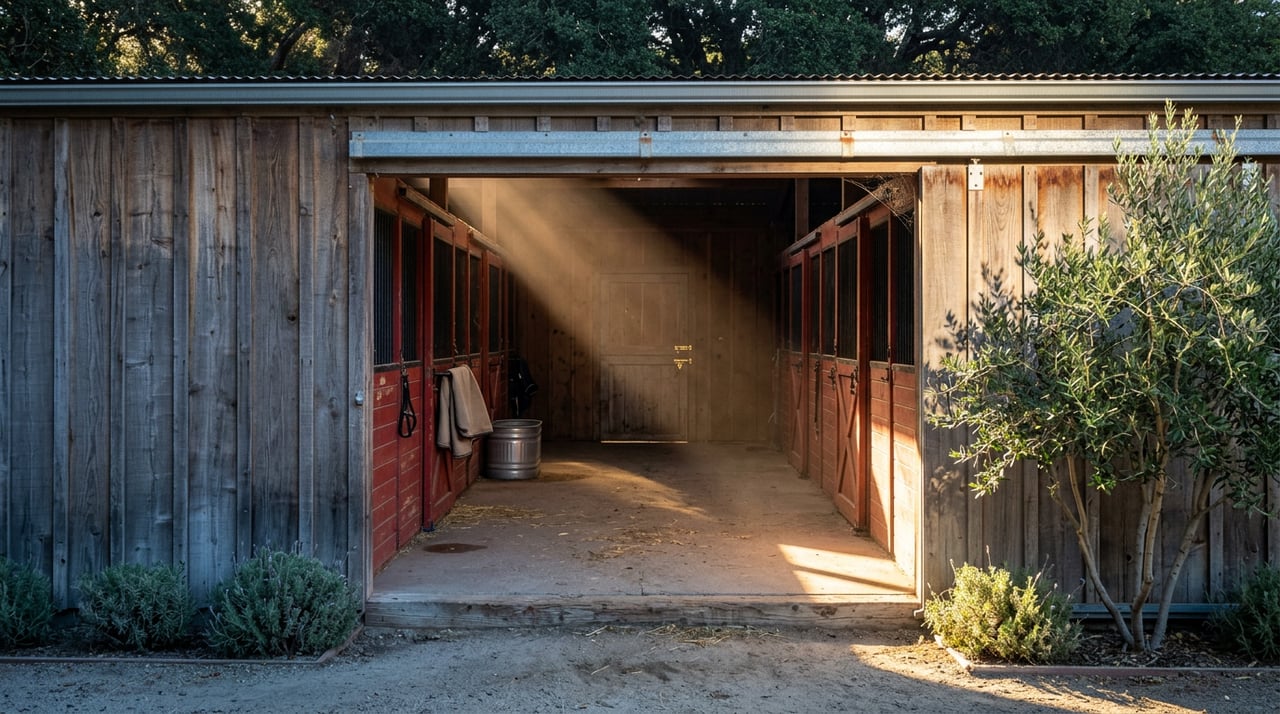
Earlier this year, the 15-acre equestrian facility at the end of Vineyard Road in Novato changed hands and reopened under a new name, Indian Valley Stables. For eight years it operated as Longview Stables, after its owners secured $2.65 million in project financing through an SBA 504 loan to buy the property back in 2018. The listing that sent it back to market described six barns, three riding arenas, two round pens, and a boarding permit good for up to 120 horses. It also carried a note most buyers skim past: the land is zoned Agricultural, and the buyer should look into the tax advantages that come with it.
That single line does more to explain how horse property pricing works in Novato than any acreage count or square footage figure ever will.
The main residence on that Vineyard Road property runs about 3,045 square feet, four bedrooms, three bathrooms. On its own, in a standard Novato neighborhood, that's a comfortable but unremarkable home. A typical single-family house in Novato sold for a median of roughly $1.1 million over the three months ending May 2026, according to Redfin, down about 4 percent from a year earlier.
But a house like that one isn't selling as a house. It's selling as the caretaker's quarters attached to six working barns, three arenas, and a private trailhead onto nine miles of trail, including access at the edge of Indian Tree Preserve. The value sits in the infrastructure and the land use rights, not the floor plan.
This is the first thing a buyer coming from a conventional home search gets wrong about Novato's horse country. You cannot price a barn property the way you'd price a subdivision listing, by comparing square footage and bed count against the median. The barns, the footing, the arenas, and the trail easements are the asset. The house is closer to a rounding error.
Here's where it gets more interesting, and where most buyers stop reading before they've learned anything useful.
Marin County offers a program called the Williamson Act, formally the California Land Conservation Act of 1965. Landowners who agree to keep their land in agricultural or open space use, and not subdivide it, can enter a contract with the county that gets their land assessed on its agricultural income rather than its market value. According to the California Department of Conservation, that arrangement is estimated to save enrolled landowners between 20 and 75 percent on their annual property tax liability. The contract runs for a minimum ten-year term and renews automatically unless either side files a notice of non-renewal.
A horse property's list price describes what it can do. Its zoning designation describes what it will cost you to keep doing it.
That's the piece a listing sheet rarely spells out in plain language. Two properties with identical acreage, identical barns, and identical trail access can carry very different annual tax bills depending on whether the parcel sits inside a designated agricultural preserve and whether a Williamson Act contract is already in place. The Vineyard Road listing hinting at "potential tax advantages" wasn't marketing flourish. It was pointing at a real mechanism that changes the math on the whole purchase, but only if the buyer follows up with the Marin County Assessor's office and confirms exactly what's in force on that parcel, because the benefit doesn't travel with the sign out front. It travels with the contract on file.
The other number that matters more than most buyers expect is what boarding actually costs around Novato, because it sets the bar that home ownership has to clear.
| Board Type | Novato Rate | California Average |
|---|---|---|
| Pasture board | About $300/month | About $456/month |
| Stall board | About $500 to $600/month | About $577/month full-care |
| Statewide blended average | About $624/month (as of June 2026) |
Novato's pasture rate sits well under the statewide pasture average, while its stall rate lands close to the statewide full-care figure tracked by Board and Stable's June 2026 survey of California facilities. Neither number is inflated for the area. That matters, because it means the baseline a Novato buyer is trying to beat by owning acreage instead of boarding isn't an artificially high one they can easily clear.
Run the numbers for a family with two horses in stall board at Novato rates and you're looking at roughly $1,000 to $1,200 a month, $12,000 to $14,400 a year, before lessons, farrier visits, or vet care. Owning your own barn only beats that if your land's carrying costs, property tax, footing maintenance, fencing, water infrastructure, come in under that figure. And carrying cost is exactly where the zoning designation and any existing agricultural contract either work in your favor or don't.
None of this happens in a vacuum. Novato has kept a real, working equestrian community even as land values have climbed. Morning Star Farm, established in 1981 along Novato Creek next to O'Hair Park, still runs lessons, camps, and boarding for beginners through experienced riders. Pencil Belly Ranch on Indian Valley Road offers boarding with direct access to Open Space trails. The Marin Horse Council keeps a running directory of local barns and organizes ride-outs and educational programs for members throughout the year.
Novato Horsemen, the county's horsemen's association, has been active since 1942 and once co-sponsored Novato's Western Weekend Parade and Rodeo, a fixture of the town's identity until 1978. That group has openly acknowledged that rising land values have made it harder to keep barns and stables running in Marin County the way they once did. The equestrian economy here is real, but it's also under the same pressure that's reshaping every acre of usable land near the Bay.
If a horse property in Novato is on your list, the questions worth asking go past "how many stalls" and "how many acres."
None of these questions show up on a spec sheet. All of them determine whether the property you're buying actually delivers the economics its listing implies.
Does every horse property in Novato qualify for a lower tax rate? No. Only land within a designated agricultural preserve that is actively enrolled in a Williamson Act contract gets the income-based assessment. That status varies parcel by parcel, and a buyer should confirm it directly with the Marin County Assessor's office rather than take a listing's mention of "potential tax advantages" at face value.
Is boarding at a place like Morning Star Farm or Pencil Belly Ranch actually cheaper than owning? It depends entirely on the property. At Novato's typical rates, boarding two horses can run $1,000 or more a month. Ownership only wins that comparison if the land's real carrying costs land below that number, and that outcome usually comes back to the same question: what is the zoning, and is there an ag contract already doing the work.
Do boarding permits like the one at the former Longview Stables property transfer automatically to a new owner? Not necessarily. Permit terms and land use approvals are tied to specific conditions set by the county, and a buyer should verify with Marin County planning staff whether an existing use permit continues under new ownership or needs to be reapplied for.
Horse property in Novato rewards buyers who read past the barn count and into the zoning file. If you're weighing acreage, boarding math, or what a specific parcel's agricultural status actually means for your budget, Cherie Callander has spent years living the country-property side of this equation firsthand and can help you ask the right questions before you write an offer. Let's connect.
Cherie is dedicated to helping buyers and sellers achieve their goals through personalized service and local expertise. With a focus on luxury and equestrian properties, she creates seamless experiences tailored to every client’s lifestyle. Experience real estate guidance rooted in integrity and care.
Cherie Callander
(707) 292-9540
[email protected]
Cherie Anne Callander | CA DRE# 02234453
W Real Estate | CA DRE# 01795950
539 Broadway Sonoma, CA 95476